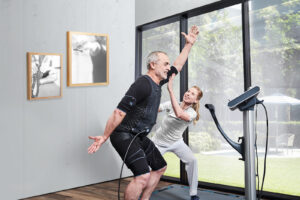
How Does Whole Body EMS Training Activate Your Muscles? The Science Behind EMS Training
Whole-Body EMS training works by adding controlled electrical stimulation to the natural electrical signals your nervous system already uses to activate muscles. During a professionally supervised EMS workout, you actively move and contract your muscles while electrodes provide an additional stimulus to multiple major muscle groups at the same time.
That sounds simple—but what’s happening inside your body is fascinating.
At Restore Health & Longevity Center in Wayne, PA, we use MIHA Bodytec Whole Body EMS Training as an efficient, highly individualized form of strength training.
Let’s look at the science behind what happens during those 20 minutes.
Your Muscles Already Run on Electrical Signals
Every voluntary movement starts with communication between your brain, nervous system and muscles.
When you decide to perform a squat, for example, your nervous system sends electrical signals to the motor neurons controlling the muscles involved in that movement. Those signals ultimately cause muscle fibers to contract.
This innovative approach to fitness, whole body EMS training, enhances muscle engagement and efficiency in workouts.
Whole-Body EMS doesn’t eliminate that process. It adds another electrical stimulus to it.
During EMS training, electrodes positioned over major muscle groups deliver controlled impulses while you actively perform guided movements. Professional WB-EMS systems can stimulate multiple major muscle groups simultaneously and allow the stimulus to be adjusted for individual regions.
What Happens When EMS Is Added?
Imagine performing a controlled squat.
Without EMS, your nervous system is recruiting muscle fibers to create the movement.
During Whole-Body EMS, you are still voluntarily contracting those muscles—but the EMS equipment is simultaneously delivering an external electrical stimulus.
That’s an important distinction:
EMS doesn’t perform the exercise for you.
You aren’t lying on a table waiting for electricity to build muscle.
You’re exercising.
The electrical stimulation is superimposed on active muscular contraction, creating an additional training stimulus while you move.
What Are Motor Units—and Why Do They Matter?
A motor unit consists of a motor neuron and the muscle fibers it controls.
Your nervous system recruits motor units according to the demands of a task. Picking up a coffee cup requires relatively little force. Performing a challenging squat requires considerably more muscular recruitment and force production.
Strength training repeatedly challenges this neuromuscular system.
EMS approaches the challenge differently by delivering electrical impulses through electrodes positioned over the muscles while you actively contract them.
The important takeaway isn’t that EMS somehow “turns on every muscle fiber”—that’s an oversimplification.
The more accurate explanation is that electrical stimulation can alter the recruitment stimulus being delivered to the muscle while voluntary exercise is occurring.
That combination is what makes Whole-Body EMS interesting as a training method.
Why Does Whole-Body EMS Feel So Different?
One of the first things new EMS clients notice is how challenging relatively simple movements can suddenly feel.
There’s a reason.
With conventional strength training, resistance typically comes from something external—a dumbbell, barbell, machine, resistance band or your own body weight.
With EMS, the additional challenge comes from electrical stimulation of the muscles while you’re moving.
And because a Whole-Body EMS system can stimulate several major muscle groups simultaneously, your legs, glutes, core, back and arms can all be working during the same movement.
That creates a very different training experience from completing separate exercises for one body region after another.
Why Can a 20-Minute EMS Session Be So Challenging?
This is where Whole-Body EMS becomes especially interesting for people with limited time.
Instead of spending an hour moving from legs to chest to back to arms, several regions can receive a training stimulus concurrently.
The session is also structured around alternating periods of stimulation and recovery.
At Restore, our EMS programming uses 4 seconds of stimulation followed by 4 seconds of recovery throughout the 20-minute training sequence.
That means your trainer can guide you through a carefully planned series of movements while coordinating those movements with the stimulation cycle.
The result is a concentrated full-body workout rather than simply a shortened traditional gym workout.
Does Research Show That Whole-Body EMS Can Increase Strength?
Yes, although outcomes depend on the population, protocol and comparison being studied.
Research has reported improvements in muscular strength and other fitness measures following WB-EMS training. Comparative studies have also found that both WB-EMS and conventional resistance-training programs can improve strength. PubMed
For example, a randomized study comparing WB-EMS with high-intensity resistance training found significant improvements in lean body mass and leg-extensor strength in both groups after 16 weeks, without statistically significant differences between the groups for those outcomes. PubMed
That’s one reason we think the more useful question isn’t:
“Is EMS better than exercise?”
EMS is exercise when used as part of an active, professionally supervised training program.
The better question is:
Which form of strength training makes sense for your body, goals and lifestyle?
We’ll explore that separately in our guide to Whole-Body EMS vs. conventional strength training.
Why Individual EMS Intensity Matters
One of the advantages of professional WB-EMS equipment is that stimulation can be adjusted according to the individual and body region.
Your glutes don’t necessarily need the same stimulation level as your arms. Your abdominal muscles may respond differently from your back.
And someone attending their first session should not train at the same intensity as someone who has gradually adapted to EMS.
This is also why more intensity is not automatically better.
International WB-EMS guidelines emphasize close professional supervision, trainer qualifications, screening for contraindications, gradual familiarization for new users and appropriate recovery between intensive sessions.
At Restore, progression is part of the training—not something we rush.
Why We Chose MIHA Bodytec at Restore
We wanted our EMS program to fit the larger philosophy behind Restore Health & Longevity Center:
Help people become stronger, move better and remain active as they age.
We also wanted EMS to be individualized rather than a one-size-fits-all workout.
MIHA Bodytec allows our trained EMS professionals to control stimulation across different regions while simultaneously coaching movement, posture, muscle engagement and exercise technique.
Technology is only part of the equation.
The trainer + the movement + the individualized stimulation create the session.
Is Whole-Body EMS Right for Everyone?
No—and that’s important.
Whole-Body EMS requires appropriate screening because certain medical conditions and circumstances may make EMS inappropriate or require medical clearance.
Published international guidelines specifically recommend reviewing contraindications and health history before WB-EMS participation.
That’s why your initial EMS experience at Restore begins with screening, education and gradual introduction to the technology.
Whole-Body EMS Training in Wayne, PA
Whole-Body EMS gives us another way to help our Restore community make strength training part of their lives.
For the busy professional, the golfer who wants a stronger core, the active adult thinking about longevity, or the person who simply hasn’t been able to stay consistent with traditional strength training, 20 minutes can make strength training much easier to fit into real life.
And consistency matters.
If you’d like to understand whether Whole-Body EMS is appropriate for you, contact Restore Health & Longevity Center in Wayne, PA to schedule your initial EMS session.
20 minutes. Full-body training. Individually guided.
Continue Learning About Whole-Body EMS
Already wondering whether 20 minutes can really be enough?
Read our guide: Can a 20-Minute EMS Workout Really Build Strength?
You can also learn more about the fundamental mechanism of EMS in this explanation from EMS-Training.com.